
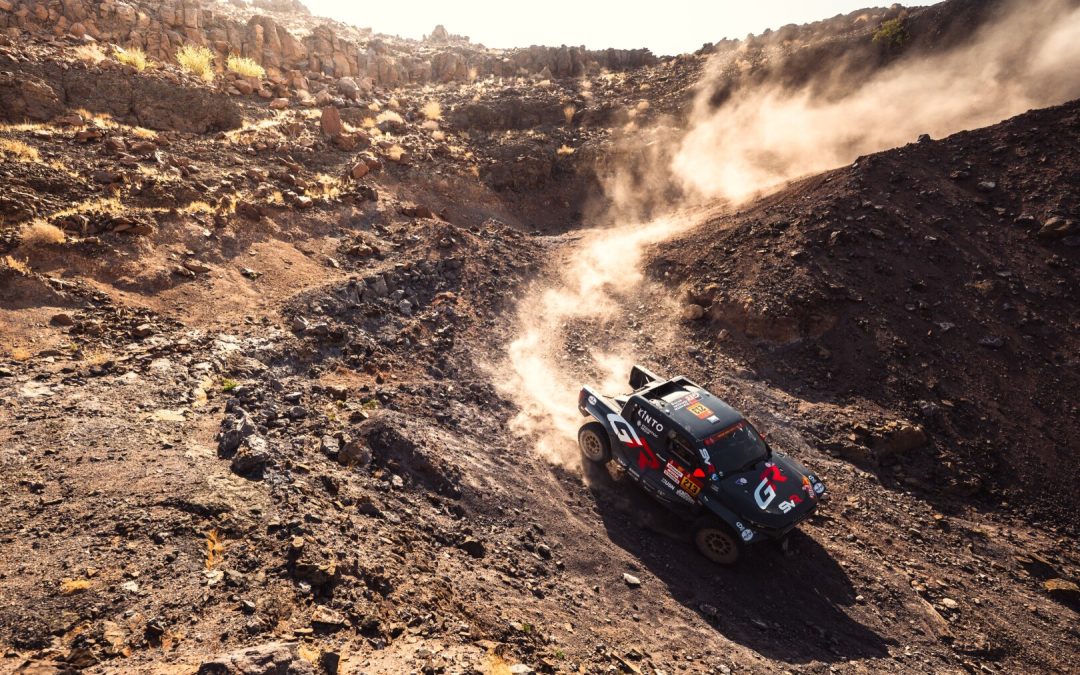
TOYOTA GAZOO Racing South Africa (TGRSA) arrived at the Rest Day of the 2026 Dakar Rally with all three crews still firmly in the fight after a punishing opening week that tested both endurance and resilience.
After six stages, Saood Variawa and Francois Cazalet hold 11th overall, João Ferreira and Filipe Palmeiro sit 12th, while Guy Botterill and Oriol Mena occupy 17th position as the rally pauses in Riyadh before the decisive second half.
While the drivers and co-drivers take a brief moment to recover, the Rest Day represents anything but a break for the technical team.
“Although it’s a Rest Day for the drivers and co-drivers, it’s a full working day for the team,” said TGRSA Team Manager Zaheer Bodhanya. “The cars undergo a comprehensive strip-down, with drivelines checked, fasteners replaced, and everything prepared for the demands of the second week.”
For Saood Variawa and Francois Cazalet (#213), the opening week has been a mix of strong pace and hard lessons. The young South African consistently showed front-running speed, including time spent at the head of the field on Stage 2, but was repeatedly slowed by punctures and, most recently, fuel management on Stage 6. Despite those setbacks, the pairing remains just under half an hour from the overall lead heading into Week 2.
João Ferreira and Filipe Palmeiro (#240) have delivered one of the standout performances of the first half of the rally, highlighted by a fifth-place finish on Stage 2 and another top-five result on Stage 6. Their pace has been undeniable, with time losses largely the result of punctures rather than lack of speed. Ferreira’s clean run through the dunes on the final stage before the Rest Day provided a strong platform to build from.
Guy Botterill and Oriol Mena (#218) endured a challenging start to the rally, including power steering issues on Stage 2 and a navigation penalty during the Marathon stage. However, their response has been emphatic. A podium finish on Stage 3 and a series of solid top-10 stage results since then have seen the pair steadily rebuild confidence and momentum as the rally progresses.
Reflecting on the opening week, Bodhanya added: “Punctures have defined much of the first week, with many crews affected by tyre issues. For us, the priority was reaching the Rest Day intact. From here on, the focus shifts to attacking the second half of the rally.”
The Dakar resumes with Stage 7, which will take crews from the Saudi capital of Riyadh to Wadi Ad Dawasir. The stage features a demanding 462 km special stage, supported by liaisons totalling 414 km, and is expected to introduce significantly more dune running. As the route heads south, navigation, tyre strategy and endurance will again be critical, with the second week set to provide a stern and unforgiving test.
Motorsport South Africa (MSA) publishes media releases from a variety of sources on its website as a service to the sport. Due to the volume of content, it is not feasible to review or approve every release prior to publication. Some news items and articles are written by independent correspondents and may not necessarily reflect the official views or positions of MSA.